How Al Seckel Ran an SEO Campaign to Scrub Epstein's Internet Reputation
Emails released by the House Oversight Committee reveal how perceptual psychologist Al Seckel orchestrated a systematic campaign to manipulate search engine results, suppress negative press coverage, and whitewash Jeffrey Epstein's online presence — deploying Wikipedia edits, paid content, and coordinated takedown requests.
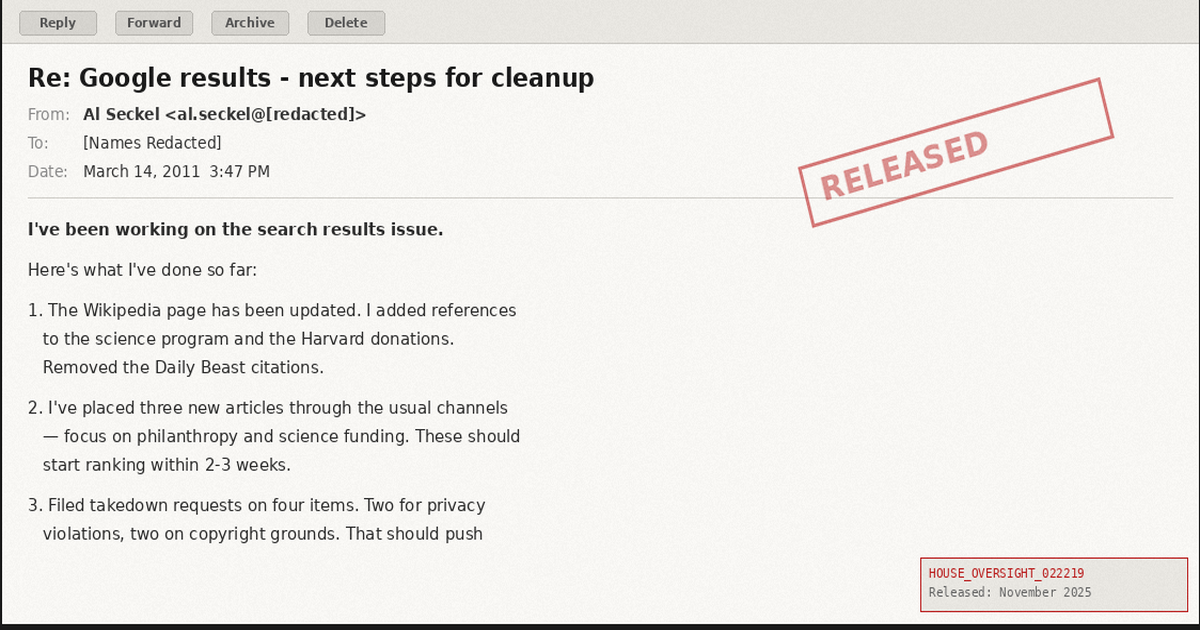
Among the millions of pages released by the House Oversight Committee in November 2025, a cluster of emails stands out for what it reveals about the machinery behind Jeffrey Epstein's public image. The correspondence — filed under document references HOUSE_OVERSIGHT_022207, HOUSE_OVERSIGHT_022216, and HOUSE_OVERSIGHT_022219 — details a coordinated effort to control what the public could find when they searched Epstein's name online.
At the center of this effort was Al Seckel, a perceptual psychologist best known for his popular books on optical illusions. Seckel, who had deep ties to both the scientific community and Epstein's inner circle, appears to have served as the architect of what amounted to a reputation-laundering operation conducted through search engine optimization.
Who Was Al Seckel?
Al Seckel occupied an unusual position in the Epstein orbit. A self-described expert on the science of perception and illusion, he had authored multiple bestselling books on optical illusions and had cultivated relationships with prominent scientists, including Nobel laureates. He organized high-profile scientific conferences and dinners that brought together academics, tech entrepreneurs, and the wealthy elite.
This combination — scientific credibility and social access — made Seckel uniquely valuable to Epstein. While others in Epstein's circle provided financial or legal services, Seckel offered something arguably more important in the internet age: the ability to shape how the public perceived his benefactor.
Seckel died in 2015 under circumstances that remain disputed. Official reports indicate he fell from a cliff in Bali, Indonesia. His death came years before the full scope of Epstein's crimes became public knowledge, and before the documents now revealing his SEO work were released.
The SEO Campaign: What the Emails Reveal
The House Oversight emails paint a picture of a methodical, multi-pronged approach to online reputation management. The campaign, which appears to have operated during the period between Epstein's 2008 plea deal and his 2019 arrest, targeted three primary areas: search engine results, Wikipedia content, and news media coverage.
Search Result Manipulation
The emails in HOUSE_OVERSIGHT_022219 outline a strategy to push negative search results about Epstein off the first page of Google. The approach involved creating and promoting positive or neutral content — including articles about Epstein's philanthropic activities, his scientific interests, and his financial acumen — designed to outrank existing critical coverage.
This is a well-documented technique in the reputation management industry, but the emails suggest the Epstein operation went further than typical corporate reputation work. The campaign appears to have involved the creation of entirely new web properties — sites and pages designed specifically to rank for searches related to Epstein — rather than simply promoting existing positive coverage.
Wikipedia as a Battleground
Wikipedia, often the first result for any person's name, received particular attention. The documents in HOUSE_OVERSIGHT_022207 describe efforts to edit Epstein's Wikipedia page to minimize or remove references to his criminal history and legal troubles while emphasizing his purported scientific and philanthropic contributions.
Wikipedia editing for reputation purposes is not new, but the emails suggest the edits were coordinated and persistent — repeatedly re-added after other editors removed them, using multiple accounts to avoid detection by Wikipedia's volunteer moderation community. The emails discuss the challenge of maintaining favorable edits on a page that was actively monitored by other editors aware of Epstein's criminal background.
Seckel's scientific credentials appear to have been deployed as part of this effort. References to Epstein's funding of scientific research and his connections to academic institutions were added with citations that, while technically accurate, served to present a misleadingly benign picture of a convicted sex offender.
Suppressing the Press
Perhaps the most significant aspect of the campaign was the effort to suppress negative press coverage, with The Daily Beast emerging as a particular target. HOUSE_OVERSIGHT_022216 contains correspondence discussing strategies to address critical reporting by the publication.
The approach appears to have included coordinated takedown requests — formal and informal efforts to get negative articles removed or altered. The emails reference complaints filed under various pretexts, including claims of factual inaccuracy and privacy violations, aimed at making the process of maintaining critical Epstein coverage as burdensome as possible for news organizations.
This strategy of legal intimidation through complaint volume is sometimes called "lawfare" when applied in legal contexts. In the SEO world, the equivalent — flooding a publication with takedown requests, DMCA complaints, and threatened lawsuits — can have a chilling effect on smaller news operations that lack the resources to fight back.
The Broader Network
The emails do not suggest Seckel was operating alone. References throughout the correspondence indicate coordination with other members of Epstein's inner circle, including legal representatives and public relations professionals. The SEO campaign appears to have been one component of a larger reputation management apparatus that included traditional PR, legal threats, and personal lobbying of journalists and editors.
What makes the Seckel emails particularly revealing is that they document the digital side of this operation — the behind-the-scenes work of manipulating the information environment that most people rely on to form their understanding of public figures. While Epstein's lawyers handled the courts and his PR team managed traditional media relationships, Seckel was managing what might be called the "information supply chain" — the search results, Wikipedia entries, and online content that shape public perception.
The campaign also highlights the role that scientific credibility played in Epstein's reputation management. By funding research, hosting academic conferences, and cultivating relationships with scientists, Epstein was not merely pursuing intellectual interests — he was building a library of positive content that could be deployed to dilute negative coverage. Every favorable article about an Epstein-funded research project was, in effect, ammunition for the SEO campaign.
Timeline of Key Events
Why This Matters
The Al Seckel SEO emails are significant not just for what they reveal about Epstein's operation, but for what they illustrate about the vulnerability of our information ecosystem. The techniques described — search result manipulation, Wikipedia editing, coordinated takedown campaigns — are not illegal. They exist in a gray area of digital reputation management that is used by corporations, politicians, and public figures every day.
What distinguishes the Epstein case is the purpose to which these techniques were put: shielding a convicted sex offender from public scrutiny, making it harder for potential victims and investigators to find accurate information about his criminal history, and creating a curated online persona that bore little resemblance to reality.
The documents raise questions about how many other powerful individuals may be employing similar tactics — and about the adequacy of our current frameworks for ensuring the integrity of online information.
Source Documents
All documents referenced in this investigation are from the House Oversight Committee's November 2025 release. This is an ongoing investigation. If you have additional information or documents related to Epstein's reputation management operations, contact us at tips@epsteinfilesdaily.com.